MILBANK CONCRETE PRODUCTS LTD
EARLS COLNE BUSINESS PARK
EARLS COLNE
COLCHESTER
ESSEX CO6 2NS
Tel: 01787 223931
Fax: estimating@milbank.co.uk



Suppliers of: Precast Concrete, Flooring, Beams & Blocks, Staircases, Landings, Hollowcore floors, concrete beams
“Delivering quality products through a sustainably conscious supply chain to help you build better”
Milbank Concrete Products is the UK’s leading manufacturer of high-quality precast concrete products. Our trading history spans over 75 years and we are dedicated to helping you succeed.
Our factory, offices and transport hub are located near Colchester on the Essex/Suffolk borders. With the A12, M11 and M25 all nearby, we are well positioned to offer a competitive service to London/Home Counties, East Anglia and the Southeast. For our specialist products including helical stairs, bespoke precast, stadia etc. we extend coverage to most of the UK.
Our team of design experts offer technical support, produce design drawings, and offer innovative design led solutions to your individual challenges. We provide valued engineering input throughout the order process to ensure you have the most efficient and cost-effective solutions available.
Our highly experienced in-house engineers and design staff provide support and advice to homebuilders, contractors, architects and engineers in the specification and design of precast and prestressed concrete products.
Precast concrete is the most commonly used building material in the world, and by manufacturing in a carefully controlled factory environment, our precast concrete is not affected by variable site conditions or the elements. With this in mind, it is a safe, reliable, long lasting and cost-effective product.
Our products are designed and supplied to exact build fit and specification which allow for improved efficiencies throughout the build process, and our range of precast components allow immediate site and finishing access following installation providing a solid footing - meaning no delays and safe access for follow-on trades.
Milbank concrete is always perfectly mixed and offers superior strength and durability in comparison to traditional, wet concrete. It is quicker than in-situ mould construction and pouring and can be made into virtually any shape. It is fireproof and will not melt at high temperatures along with being tough and durable with excellent exposure properties. It is wholly resistant to insect, pests, vermin attacks, fungus, and mildew. It is completely recyclable, and all precast units can be re-used in their entirety at the end of their life.
How we’re making a difference
We have been proactive in adapting our processes to work towards carbon neutrality, introducing both a wood pellet fuelled biomass boiler and electric vehicle charging points for staff and visitors.
On top of this, we have successfully transitioned 100% of our production machinery, including fork trucks, loading shovels, shunters, dumpers, cherry pickers and prestressed concrete manufacturing machines from the use of regular diesel to HVO – a hydro-treated vegetable oil biofuel.
By adopting 100% HVO, greenhouse gas emissions produced by our machinery reduced by up to 90%, with a 35% reduction in particulate mass and a 30% reduction of CO2 company wide.
What we offer:
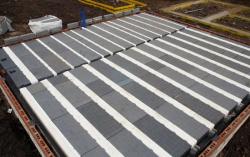
Milbank Hollowcore floors are prestressed concrete units with tubular voids extending the full length of the slab creating an efficient lightweight unit. This makes the slab much lighter than other floor slabs of equal thickness or strength. Reduced weight lowers transportation costs and saves on the cost of the material. They are typically used in the construction of upper floors in apartments/flats, commercial buildings and larger houses. Milbank hollowcore floors are available in 150mm, 200mm and 250mm deep units.
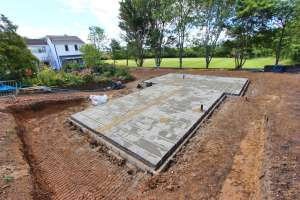
There are many benefits to using a beam & block flooring system - it is fast, cheap, and simple to install with no special skills required. Our concrete beams come in 155mm and 225mm deep prestressed options and are available in lengths of 1-6m in 50mm increments. By varying the concrete beam centres during construction, this kind of concrete flooring offers a quick and economical solution for a wide range of problems both at ground and upper floor levels.
WarmFloor Pro Insulated Flooring
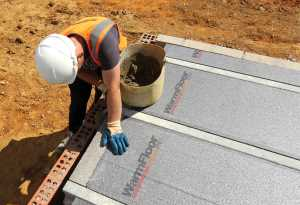
WarmFloor Pro offers homebuilders a simple and cost-effective solution to quickly construct a thermally insulated ground floor, providing reduced initial construction costs and lowering heating costs, making a compelling alternative to a standard beam and block floor.
The floor is easily assembled using lightweight expanded polystyrene (EPS) blocks placed between our standard Milbank pre-stressed concrete beams (either 155mm or 225mm deep) in replacement of standard concrete infill blocks and then finished with a structural concrete screed.
A+ green guide-rated and fully certified, it is proven to be a must-have addition to any new, sustainable development, where keeping heating costs low is paramount. WarmFloor Pro has already been successfully installed in thousands of new-build projects across the country, and we are well experienced in both supply only and Supply and fix requirements.
Bespoke Precast Concrete Products
Milbank manufactures a wide variety of bespoke precast concrete components, up to 15 tonnes, in our modern purpose-built factories. We work together with clients from industries including Commercial and Residential Construction, Rail, Health, Energy, Environmental and Public Sector to name but a few. Whatever industry you work in, we’re confident that we can provide the bespoke precast concrete products you need as a solution to many common problems.
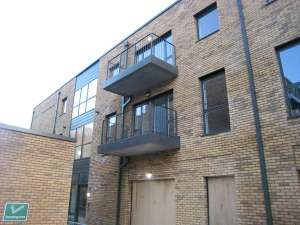
Milbank offers a range of precast concrete balcony types to suit your project requirements. All our balconies are designed by our in-house design team and manufactured, delivered and installed to the highest standards. When designing the precast concrete floors for a project, Milbank will take into consideration the design of the balconies, providing a complete package solution.
Spiral, Curved & Helical Stairs by Kallisto
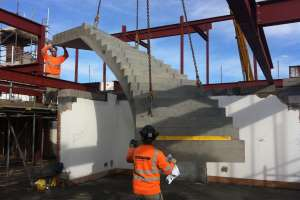
As part of Milbank Concrete Products, Kallisto Stairs expertise has been commissioned for staircase installations in some of the most prestigious venues in the UK. Working with architects, engineers, and designers, we have achieved stunning, durable, precast spiral staircase installations. Today, the versatility of precast concrete, together with innovative engineering and finishing processes, allow us to create bespoke spiral staircases that are both visually pleasing and exceptionally resilient. Utilising leading Northern European manufacturing technology, our palletised formwork and precast shuttering system ensures the finish is of the highest quality.
Milbank are specialists in precast concrete stair and landing design, manufacture, and installation. With an experienced team and a dedicated production facility, we produce both simple and standard flights as well as complex bespoke units to meet your exact requirements. We take great pride in offering full-package solutions that save time, reduce costs and increase the build time of your project.
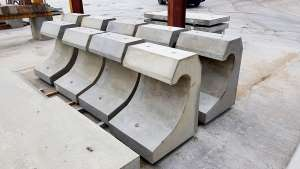
Milbank Ground Beams provide a great alternative to traditional foundations, and we manufacture specific ground beams for a number of leading contractors. Ground beams are designed to support brick or block work and steel frames and can be used to form a permanent shutter to the edge of an in-situ concrete floor slab. They are generally square or rectangular in section however, notches, sloping faces, and end details can also be incorporated.
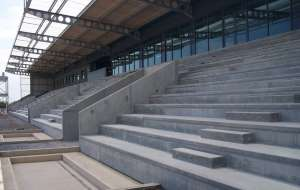
Most modern stadia are constructed using steel structures with precast concrete elements to form the terracing, walling, stairs, and circulation areas. Concrete frame structures comprising beams, columns, walls, floors, stairs, and terracing can be used for a wide variety of applications including multi-storey car parks, retail and leisure developments, offices, schools, hospitals, cinemas, theatres etc. These structures can be built entirely from precast concrete but more commonly will be of hybrid construction comprising in-situ concrete or steel elements together with precast components.
Our coastline is valuable for both economic and social reasons, but it is a varying environment that naturally evolves through coastal erosion and flooding processes. Whether the requirement is complete wave walls or copings to refurbish existing defences, Milbank provide high-quality precast concrete blocks to resist natural processes such as wave action and sediment movement. We also work closely with the Environment Agency in supplying Canewdon blocks which are often laid in grid formation at the toe of the sea wall.
Social Media: Facebook / Twitter / Linkedin / Instagram / YouTube
Further technical information, image galleries and product specifications are available through the Milbank Precast Concrete website or via the BPi Download Library.
Milbank - We’ve Improved How We Build. Now It’s Time to Improve What We Build With.
 Construction has never stood still.
Over the years we’ve found quicker ways to build, safer ways to work and more efficient ways to manufacture. We’ve embraced modern methods of construction, invested in automation and kept looking for ways to improve quality and performance.
That’s how our industry moves forward. But while we’ve spent years improving how we build, I think we now need to pay just as much attention to what we build with.
For me, that’s one of the biggest opportunities we’ve got. We’ve made huge progress in improving the operational performance of buildings. Better insulation, more efficient heating systems and smarter design mean we’re constructing buildings that use far less energy than they did even a decade or two ago.
But as operational emissions come down, the carbon that goes into constructing those buildings in the first place becomes harder to ignore.
Embodied carbon covers the emissions associated with extracting raw materials, manufacturing products, transporting them to site and constructing a building. And unlike operational carbon, you can’t go back and reduce those emissions later. Once a building is built, they’re already there.
According to the Royal Institution of Chartered Surveyors (RICS), embodied carbon already accounts for around 10% of the UK’s greenhouse gas emissions, while globally the built environment is responsible for almost 40% of energy-related carbon emissions.
Those are big numbers, and they’re only going to come under more scrutiny.
The Industry Is Moving
I’ve been in this industry long enough to know that construction doesn’t change overnight. But you can usually tell when something has moved from being talked about to something people genuinely have to deal with.
I think we’re at that point with embodied carbon. Five or ten years ago, it wasn’t a topic that came up in many of our conversations. Today, it’s increasingly influencing the way major projects are designed, specified and procured.
Architects are being asked to design for lower whole-life carbon. Structural engineers are looking at how they can reduce embodied carbon without compromising performance. Contractors are being asked to demonstrate their sustainability credentials at tender stage. And procurement teams aren’t only looking at price and programme anymore. They want credible carbon data from suppliers alongside products they know will do the job.
Embodied carbon isn’t currently regulated through the UK Building Regulations, but Whole Life Carbon Assessments are becoming more common, Environmental Product Declarations (EPDs) are carrying more weight and proposals such as Part Z are keeping the issue firmly on the agenda.
Whether legislation comes next year or further down the line isn’t really the point. Customers are asking the questions now.
Let’s Be Honest About Concrete
Concrete isn’t going anywhere.
It’s one of the most dependable, versatile and durable construction materials we’ve got. We use it to build homes, schools, hospitals, commercial buildings and a huge amount of the infrastructure we rely on every day. For me, the conversation shouldn’t be about whether we use concrete. It should be about how we make better use of it and how we reduce its impact.
Cement production is one of the biggest contributors to concrete’s embodied carbon and is estimated to account for around 8% of global carbon dioxide emissions. It’s why there’s so much work going on across our industry around alternative cementitious materials, lower carbon mix designs and better manufacturing processes.
Innovation doesn’t always have to mean coming up with something completely new. There’s a lot to be said for taking something we know works and finding a better way of making it.
Hollowcore is a good example.
On a large residential or commercial development, you can have thousands of square metres of flooring. Reduce the embodied carbon across every square metre and suddenly you’re talking about a substantial saving across the project.
And if you can achieve that without asking the contractor to change how they build, or the engineer to compromise on performance, it starts to become a very practical way of reducing carbon.
That’s the sort of progress I’m interested in.
The Challenge We Set Ourselves
At Milbank Concrete Products, we’ve been asking ourselves a fairly straightforward question:
How can we help our customers reduce embodied carbon without making their lives more difficult?
Because if an innovation creates another headache on site or adds unnecessary complexity to a project, you’ve got to question how useful it really is.
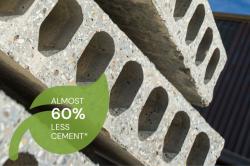
We’re currently trialling a new Ultra Low Carbon Hollowcore concrete mix with almost 60% less concrete when compared with our 2018 baseline.
What interests me about what we’re developing is that we’re not asking customers to completely rethink how they use Hollowcore. We’re working towards the same structural performance, reliability and installation benefits they’re used to, but with significantly less embodied carbon in the product itself.
For a contractor, engineer or specifier, that matters. If we can help them lower the carbon impact of a project without changing the way they design, specify or install the floor, then we’re making it easier for them to make a lower carbon choice.
Giving Customers Something They Can Actually Use
Sustainability is becoming a much bigger factor in how projects are specified, procured and delivered. But clients quite rightly want more than a manufacturer telling them a product is “green” or “sustainable”. They want to understand the difference their specification choices could make.
An architect needs confidence that the materials they’re specifying have the potential to reduce embodied carbon. An engineer needs to know that this doesn’t come at the expense of structural performance. A contractor needs products that work with the programme and don’t create problems on site. And procurement teams increasingly need robust data to support their decisions.
That’s why we developed our Carbon Reduction Calculator to help customers better understand the potential carbon savings of our product range.
The calculator enables customers to compare our Ultra Low Carbon Hollowcore and other lower carbon products against our 2018 baseline, providing indicative carbon savings based on the information currently available. As our Environmental Product Declarations (EPDs) are completed, we’ll also be able to provide more detailed data to support tender submissions and project specifications.
Our aim isn’t simply to develop lower carbon products. It’s to give customers greater visibility into the carbon impact of their specification decisions, backed by transparent data that supports more informed choices
Where We Go From Here
We’ve still got work to do. Our Ultra Low Carbon Hollowcore is currently in trials, and we won’t bring it to market until we’re satisfied it delivers the quality, consistency and performance people expect from Milbank. We’re also working towards securing the relevant EPDs so customers have independently verified data behind the product.
But what we’ve seen so far gives me real confidence.
I think this could make a significant difference, particularly on larger projects where the carbon savings quickly start to add up.
And that’s ultimately what we’re trying to achieve.
Construction doesn’t need another sustainability claim. It needs practical ways of reducing carbon that architects can specify, engineers can have confidence in and contractors can actually build with.
If we can deliver that while keeping all the things that already make Hollowcore work, then we’re moving in the right direction.
Sometimes progress isn’t about inventing something completely new. It’s about looking at something that’s worked for decades and asking a simple question: Can we make it better?
Milbank Concrete -The Opportunity and the Oversight of The Future Homes Standard 2027
 The Future Homes Standard is set to transform the UK housing landscape from 2027, but while the ambition is clear, so too are the challenges that lie ahead.
Builders are already navigating a difficult environment. Viability remains a constant concern, with rising material costs, planning delays and margin pressures continuing to impact delivery. At the same time, the industry faces an acute skills shortage, particularly in the specialist areas required to deliver higher-performing, low-carbon homes. Against this backdrop, the introduction of stricter regulatory standards adds another layer of complexity.
Yet perhaps the most significant issue is what the Future Homes Standard does not fully address. While it rightly focuses on reducing operational carbon through improved energy efficiency and low-carbon heating systems, it stops short of tackling embodied carbon within the construction supply chain. This omission creates a risk that, in striving to reduce emissions in use, we inadvertently increase emissions in construction.
This is where the conversation must evolve, and where materials such as concrete need to be better understood, not simply scrutinised.
A Standard Focused on Operational Carbon
The Future Homes Standard builds upon Part L of the Building Regulations, pushing for a 75% to 80% reduction in carbon emissions compared to current benchmarks. In practice, this means better insulated building envelopes, reduced heat loss and a shift away from fossil fuel heating systems.
These are all positive and necessary steps. However, focusing solely on operational performance only tells part of the story. Embodied carbon, the emissions associated with the production, transportation and installation of materials, can account for a significant proportion of a building’s total carbon footprint. As operational emissions decrease, embodied carbon becomes an even greater share of the whole.
If it is not addressed now, it risks becoming the next major regulatory challenge.
Rethinking Concrete’s Role
Concrete is often at the centre of this debate. It is a material that is both essential and, historically, carbon intensive. But the narrative is changing. The question is no longer whether concrete has a role to play in a low-carbon future, but how the industry can innovate to reduce its impact while maintaining the performance, durability and efficiency that modern construction demands.
Precast concrete, in particular, offers a compelling solution. Its factory-controlled production ensures precision and consistency, reducing waste and improving quality. Its inherent thermal mass can support more stable indoor temperatures, complementing the energy efficiency goals of the Future Homes Standard. Its durability also contributes to longer building lifespans, reducing the need for replacement and lowering whole-life carbon emissions.
Importantly, this performance can be further enhanced through precast flooring solutions from Milbank Concrete Products, such as GDeck and WarmFloor Pro, which are specifically designed with thermal efficiency and compliance in mind. By integrating insulation and structural performance into a single system, these solutions help developers meet evolving standards while also improving buildability on site.
The real opportunity lies in how we manufacture it.
Driving Down Embodied Carbon in Practice
At Milbank Concrete Products, we have taken significant steps to reduce the embodied carbon of our products without compromising on performance. Through the adoption of advanced cement replacement technology, we have reduced cement content in our mixes by up to 21 percent. This single change is projected to remove over 2,800 tonnes of CO₂e from our products each year.
We are currently in the process of trialling enhanced new concrete mixes which will improve this saving even further in some of our industry leading products, including Hollowcore.
Importantly, this innovation also delivers improved early strength and enhanced surface finish, demonstrating that sustainability and performance can go hand in hand.
These advancements also feed directly into the development of systems like WarmFloor Pro, where improved thermal performance and reduced embodied carbon combine to support both regulatory compliance and long-term energy efficiency for homeowners.
A Holistic Approach to Sustainability
This focus on product innovation forms part of a much wider sustainability strategy. Since 2018, we have reduced our operational CO₂ emissions by 61 percent, bringing them down to just 350 tonnes. We have committed to achieving net-zero Scope 1 and 2 emissions by 2030, twenty years ahead of government targets, and are actively developing our Scope 3 roadmap.
Our approach extends across every aspect of our operations. From transitioning our delivery network to 100 percent renewable HVO biofuel, to investing in solar energy that now generates over 300,000 kWh annually, we are reducing emissions at source. The introduction of our on-site borehole and closed-loop water system ensure a more sustainable approach to water usage.
Equally important is transparency. Our in-house Carbon Reduction Calculator provides customers with clear, product-specific CO₂ data as part of every quotation, enabling more informed decision-making at every stage of a project.
This level of transparency is particularly valuable when specifying integrated systems where both structural performance and thermal benefits can be clearly quantified within the overall carbon assessment of a build.
Collaboration Will Be Critical
These are not just environmental initiatives, they are commercial factors. As the regulatory landscape evolves, developers will increasingly need partners who can demonstrate measurable carbon reductions and support compliance in a practical, cost effective way.
However, no single organisation can address this challenge alone. The Future Homes Standard will require a coordinated effort across the entire construction supply chain. Manufacturers, contractors, designers and policymakers must work together to ensure that both operational and embodied carbon are considered in tandem.
Looking Beyond 2027
There is a real opportunity here to rethink how we build, not just to meet minimum standards, but to create genuinely sustainable homes for the future. But to do so, we must acknowledge the full picture.
The Future Homes Standard is a significant step forward, but it is not the complete solution. Addressing embodied carbon will be critical if we are to future-proof our housing stock and deliver on the UK’s broader net-zero ambitions.
For the concrete sector, this is both a challenge and an opportunity. By continuing to innovate, invest and collaborate, including through advanced product solutions, we can ensure that concrete remains a vital, sustainable material at the heart of modern construction.