
AKZO NOBEL DECORATIVE PAINTS
WEXHAM ROAD
SLOUGH
BERKSHIRE SL2 5DS
Tel: 0333 222 7070
Fax:



Suppliers of: Metal Paints Polycell Polyfilla Interpon Powder Coating International Marine Coatings
AkzoNobel is the world’s leading decorative paints and performance coatings manufacturer. Our portfolio includes market-leading brands such as Cuprinol Trade, Dulux Trade, Armstead Trade, Hammerite, Polycell Trade, and Sikkens.
This page will help you to source the right brand and product from the Akzo Nobel range of Decorative Paints and Coatings.
You may use the following links to view our brand profiles on Building Products Index and access PDF Downloads for:
Dulux Trade Paints: Click Here
Armstead Trade: Click Here
Sikkens Woodcare: Click Here
Other Brands and Products:
The following Brands are not listed on Building Products Index, but you can use the links provided to access their home websites:
Polycell Trade UK
Formulated specifically for professional decorators by ICI Paints AkzoNobel to guarantee superb predecorative results.
Hammerite Metal Paints
Hammerite Metal Paints offer long lasting protection, plus a great looking finish for both interior and exterior metal finished.
International Marine & Protective Coatings
Provide durable coatings for all types of applications from Marine to Construction.
Interpon Powder Coatings
The world leader in powder coatings. We offer effective coatings solutions for a wide range of applications, including furniture, automotive, IT, appliance, the architectural market and general industry.
Cuprinol Trade Wood preservation, treatment, stains and Paints
With unrivalled experience and expertise, no-one knows more about landscape woodcare than Cuprinol Trade.
Further technical information is available to downlaod from the BPi download Library or by following the above links to visit the Manaufacturer’s own websites.
What is Awaab’s Law?
 In October 2025, the Hazards in Social Housing (Prescribed Requirements) (England) Regulations 2025 came into force. The new legislation is also known as Awaab’s Law, named after two-year-old Awaab Ishak, who tragically died after prolonged exposure to mould in his home.
Awaab’s Law sets strict timescales for evaluating and addressing hazards under the Housing Health and Safety Rating System (HHSRS), including damp and mould—two of the most common and persistent issues in UK housing stock.
What the new law means for social housing landlords
It requires landlords to investigate and resolve dangerous damp and mould that poses a significant risk to health and safety. The problem must be investigated within 10 working days and then made safe within a further 5 working days.
These deadlines are intentionally tight. The aim is to prevent the long-term neglect of damp-related issues, which can quickly escalate into structural deterioration, material failure, and occupant health risks.
For specifiers and contractors, this means maintenance solutions—particularly coatings systems—must be efficient, reliable, and engineered to perform in challenging environments. Long-drying products, multi-stage systems or products unsuitable for damp-prone substrates can cause delays that risk non-compliance.
Why damp and mould persist
Damp and mould are common problems in older houses, especially in buildings without modern damp-proof courses or membranes. Moisture can enter a building's structure through rising damp, penetrating damp, or condensation. Once moisture appears, mould can develop quickly.
As a fungus, mould releases spores and volatile compounds into the air, which can be harmful to all occupants and particularly dangerous for vulnerable groups such as children and those with compromised immune systems.
Left untreated, damp and mould can:
Damage plaster, timber, paint films and finishes
Erode the structural integrity of walls and floors
Create unhealthy indoor environments
Require costly, invasive remediation works later on
Lead to legal liability under the new legislation
This makes an accurate diagnosis crucial. Painting over mould, even with a mould-resistant paint, without tackling the underlying moisture first, is pointless. The mould will just grow back, often more quickly than before, and the problem may embed itself deeper into the building structure. If this stage is skipped, any subsequent coating—even the best anti-mould paint —cannot deliver long-term protection.
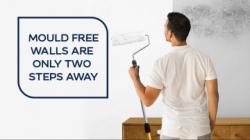
Prep then paint: a 2-step solution to mould-free walls
Once the root cause has been identified, the first step is to eliminate the mould and prep the surface. This involves removing not just visible mould but also the microscopic organisms embedded in the surface. We recommend using a fungicidal wash, such as Dulux Trade Weathershield Fungicidal Wash, and a mould spray, such as Polycell Mould Remover. Both of these products contain powerful active ingredients that destroy mould at its source, helping to ensure the long-term success of the coating system applied afterwards.
Step 1: Preparation
Good surface preparation is essential to achieving a durable, high-quality finish. So, after mould removal, it’s worth treating the substrate with a stain-blocking primer such as Dulux Trade Aqua Uniprimer, to help prevent residual staining from seeping through the new paint film. It’s worth noting that Dulux Trade Aqua Uniprimer is a multi-functional primer, acting as a primer, sealer, stain block and undercoat in one – maximising efficiency and delivering consistent performance across a range of interior and exterior substrates.
Step 2: Apply a high-performance paint
Once preparation is complete and the surface is fully dry, the topcoat can be applied. For properties at risk of damp and mould, we recommend using fungicidal paints such as Dulux Trade Mouldshield Fungicidal Matt and Eggshell. Both of these high-performance products contain a special fungicide that inhibits the growth of fungi and mould in buildings. Their antifungal properties make both coatings ideal for most interior walls and ceilings likely to be disfigured by mould. In areas where heavy condensation or splashing water is common, such as kitchens and bathrooms, we recommend using Dulux Trade Mouldshield Fungicidal Eggshell, which offers enhanced moisture resistance.
Awaab’s Law puts the well-being of social housing residents firmly at its centre. So it’s vital to specify coatings that help protect the health of occupants living in damp, mould-prone spaces. With our highly durable, anti-mould paints available in a wide range of colours, Dulux Trade offers a solution you can specify with confidence.
AkzoNobel names ‘Sweet embrace’ as the Interpon Color of the Year 2024
 When life is complex and we’re experiencing information overload, we need spaces that offer us the simplicity to clear our minds, decompress and understand the things we really need. Whether at home or at work, in a school or a hospital, or wherever we find ourselves, we need spaces where we can feel comfortable and relaxed.
In this context we introduce ’Sweet embrace’ the Interpon Color of the Year 2024, a delicate shade of soft grey with a hint of violet, and a subtle metallic effect, a color with a gentle optimism that is both understated yet liberating.
The color of the year is launched as part of a complementary palette to transform exteriors, interiors, lighting, furniture, and furnishings across a wide range of sectors.
Within the palette are a number of blues, greens and natural browns in metallic, smooth and fine texture effects that recall shades of seascapes and woodlands. These shades have a natural calming and clarifying effect and will help a building be at home in the surrounding landscape allowing even modern, high-tech buildings to blend with the natural environment.
Expert color scientists, designers and architects from around the world and the AkzoNobel’s Global Aesthetics Center have accessed more than three decades of color research and analysis to ensure the Color of the Year 2024 and its palette are on-trend.
Bob Dirks, Global Segment Manager Architectural AkzoNobel Powder Coatings, says: “People today need simplicity more than ever. Wherever they are, they need a safe haven, a place where they belong.
With 10 colors to choose from, mixing darker shades with lighter neutrals, this palette offers architects and designers the opportunity to create subtle coordination or contrast with the objects and buildings they design that will impress and delight for many years to come.”


