ION Glass - Fire-rated glass: safety without losing the light
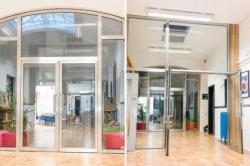 Fire safety is a key consideration in any public building or apartment block. Fire-rated glass allows architects, building managers and owners to install fire-resistant doors, walls and screens, while still maintaining light and visibility through the building.
Fire rated glass doors to infant school
During normal use, fire-rated glass looks almost identical to conventional architectural glass. But in the event of a fire, it resists flames, smoke and heat, helping to protect escape routes and the safe exit of everyone in the building.
Every project is different — the location, the level of fire performance required, and the site-specific stipulations agreed with your local Building Control all shape the specification. Our expert designers at Ion Glass work with you from the outset to ensure the correct glass is specified for your project.
How does fire-rated glass work?
Different types of fire-resistant glass use different technologies. The most commonly specified option, has an intumescent interlayer that expands and turns opaque when exposed to fire, creating an insulating barrier.
The key question is how long the glass will hold that resistance in the event of a fire. The letters E, EW or EI identify the performance each type of glass provides, and the number records how many minutes it will sustain — for example E30, EW60 or EI60:
E — Integrity: resists flames and hot gases, without the same control of heat transfer as insulated glazing
EW — Integrity and radiation control: resists flames and hot gases, and limits radiant heat to the classified level
EI — Integrity and insulation: resists flames and hot gases, and limits the temperature rise on the protected face
Fire-rated glass is not a standalone product
Fire-rated glass needs to be considered alongside the frame, fixings, seals and surrounding construction, as part of a wider, expertly specified glazing system. Ion Glass will work with you, your architect or your contractor to confirm:
the exact glass type and thickness
the frame material and profile
fixings, edge cover, clearances and fire-resistant seals
the maximum approved pane dimensions
the supporting wall, partition or door construction
Discuss your project
Where is fire-rated glass used?
In public and commercial buildings, fire-rated glazing is often specified where visibility and daylight matter but the fire strategy requires a protected boundary — glazed fire doors, side panels and overpanels; protected corridors, lobbies and stair enclosures; reception areas and screens between circulation spaces; and churches, listed buildings and places of assembly.
At Hastings Library, a Grade II listed building undergoing its first major refurbishment in 140 years, Ion Glass installed automatic fire-rated glass doors, all designed to preserve sightlines to the original architecture. As the client put it: "The fire-rated glass doors with automatic closures were integral to the success of the refurbishment project, ensuring that this impressive Grade II listed building fully meets current building requirements without losing the heritage features."
Book a Call Tel 0345 658 9988
Expertise That Delivers the Exceptional
Ion Glass will discuss your building, the proposed location of the glazing, and the design before working with you to develop the details. Where fire performance is required, we work to the specified classification, coordinating the glass with the appropriate framing, seals, fixings and surrounding construction.