Lignacite achieves PAS 2080 certification for carbon management
November 2026
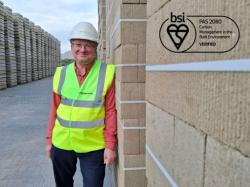 Lignacite has become one of the first concrete block manufacturers to achieve PAS 2080:2023 certification as a construction material supplier. This achievement recognises our commitment to managing and reducing carbon emissions across the business.
Awarded in September 2026, the certification covers our manufacturing sites in Suffolk and Essex. It provides independent assurance of our approach to carbon management, giving architects, specifiers and contractors greater confidence in our environmental credentials.
What is PAS 2080?
PAS 2080:2023 is a voluntary specification for carbon management in buildings and infrastructure. It sets out a framework for measuring, managing and reducing whole-life carbon emissions throughout a building’s lifecycle.
Developers, designers, contractors and material suppliers can all apply for certification, which demonstrates that their business has established processes for managing carbon emissions, setting reduction targets and monitoring its progress. Importantly, it also requires an ongoing commitment to minimising carbon emissions, rather than simply meeting requirements during the assessment period.
Building on previous activity
For Lignacite, achieving certification was a natural progression of our environmental work. Our SHEQ Manager, Marvyn Candler, estimates that we were already meeting around 70-80% of the standard’s criteria when we started to pursue certification.
“For several years, we’ve been strengthening our carbon management processes and improving the transparency of our emissions reporting,” he explains. “We’ve also invested in practical measures to reduce our environmental impact. This includes switching to hydrotreated vegetable oil (HVO) as an alternative to conventional diesel, along with harnessing solar energy at our Brandon factory.”
Product innovation has been another priority. In May 2025, we launched the Lignacite ECO Range, featuring blocks with 50-70% recycled content and independently verified Environmental Product Declarations (EPDs). We're continuing to develop the range, with an upgraded ECO block due to launch in November 2026. To be among the first to hear about the new product, visit our dedicated ECO Range website and sign up for updates.
These initiatives, together with our established carbon monitoring and reporting processes, meant much of the groundwork for certification was already in place.
Following an independent gap analysis in January, a Stage 1 audit in April and a Stage 2 audit in September, we successfully completed the certification process in September 2026. In fact, we progressed through both the stage 1 and stage 2 audits no non-conformities raised at all, which the auditor commented was rare.
An aerial view of our Brandon manufacturing plant, as we strengthen our approach to carbon management with PAS 2080.
Giving customers confidence
For architects, specifiers and contractors, PAS 2080 certification offers additional reassurance that our environmental commitments are supported by independently assessed processes and robust evidence. It complements our existing EPDs, which provide verified environmental impact data for individual block ranges.
As Marvyn explains: “We don’t just say our blocks are low carbon. We’ve got the evidence to prove it. Our carbon management processes are independently scrutinised, and that helps reinforce trust with our customers.”
By sharing reliable environmental data, we can help construction partners make informed material choices and identify opportunities to reduce carbon emissions across their projects.
Dedicated to ongoing improvement
Achieving PAS 2080 certification is an important milestone, but it’s also an ongoing process. Under the three-year certification cycle, we will undergo annual audits to demonstrate how we’re continuing to manage and reduce carbon emissions. The auditors will also assess evidence of new projects and initiatives undertaken since the last assessment.
This focus on continuous improvement is already shaping our plans. We’re working to upgrade the existing solar panels at Brandon, while plans for a new solar installation are progressing at Nazeing. We’re also investigating ways to reduce our reliance on virgin aggregates and conventional cement. This includes exploring the use of ground granulated blast-furnace slag (GGBS), an alternative cementitious material that could help lower the embodied carbon of our blocks.
For Marvyn, who has been instrumental in driving our carbon management initiatives and achieving certification, the motivation is about more than meeting industry standards.
“This isn’t our planet. We borrow it from the children of the future,” he says. “What we do today can make a difference tomorrow.”
It’s a principle that will continue to guide our approach as we work to reduce our carbon footprint and help our customers create a greener built environment. Visit our Sustainability page to discover how we’re minimising our impact and helping build a more sustainable future for the UK construction industry.